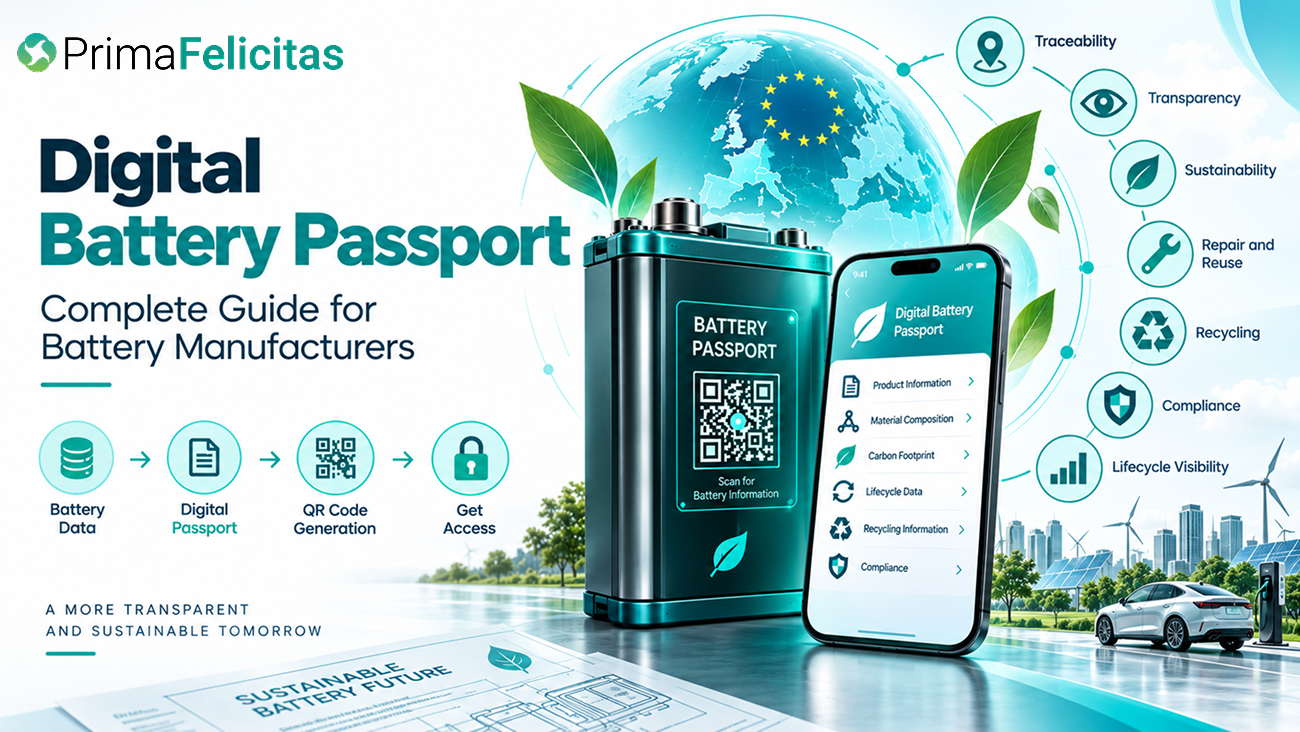
What Is a Digital Battery Passport?
Answer: A Digital Battery Passport (DBP) is an electronic record containing information about a battery model and, where required, the individual battery throughout its lifecycle. Under the EU Batteries Regulation, the Battery Passport becomes mandatory from 18 February 2027 for each LMT battery, industrial battery above 2 kWh, and electric vehicle battery placed on the EU market or put into service.
In simple terms
Battery data is extracted; from it, a digital passport is created, then a QR code is generated, and then get the access is obtained.
Why Is the Digital Battery Passport Important?
The Battery Passport creates a digital information layer that makes important battery data accessible to the right stakeholders throughout the battery lifecycle.
It supports:
- Traceability: connect a battery to its digital identity
- Transparency: make required information accessible
- Sustainability: support circularity and responsible battery management
- Repair and reuse: provide relevant information to authorised stakeholders
- Recycling: support dismantling and end-of-life processes
- Compliance: support EU regulatory requirements
- Lifecycle visibility: keep relevant battery information connected over time
The European Commission describes the Battery Passport as a tool for improving transparency and sustainability across the battery value chain.
When Does the Digital Battery Passport Become Mandatory?
18 February 2027
| Date | Milestone |
| 20 July 2026 | EU DPP Registry Becomes Operational |
| 21 August 2026 | Updated commission battery passport data point guidance published |
| 24 August 2026 | 178 days before the DBP deadline |
| 18 August 2026 | Battery passport becomes mandatory for covered batteries |
The EU Digital Product Passport Registry became operational on 20 July 2026.
Which Batteries Need a Digital Battery Passport?
From 18 February 2027, the requirement applies to:
| Battery category | Battery passport |
| Electric vehicle batteries | Required |
| LMT batteries | Required |
| Industrial batteries > 2 kWh | Required |
| Other battery categories | Check applicable EU requirements |
The legal requirement specifically covers each LMT battery, each industrial battery with a capacity greater than 2 kWh, and each electric vehicle battery placed on the EU market or put into service.
Who Is Responsible for the Battery Passport?
The obligation lies with the economic operator placing the finished battery on the EU market or putting it into service.
The responsible operator must:
- Create the Battery Passport
- Provide the required information
- Keep the information accurate and up-to-date
- Ensure the required information is accessible
- Manage the Battery Passport throughout its lifecycle
- Meet the applicable technical and regulatory requirements
The European Commission specifically distinguishes the responsible economic operator from suppliers of individual battery components or modules.
Responsibility flow
- Economic Operator
- Battery
- Passport
- Maintain
What Information Does a Battery Passport Contain?
The Battery Passport contains information about the battery model and the individual battery, including information resulting from its use, as specified by the Batteries Regulation and Annex XIII.
| Data area | Example |
| Identification | Battery and model identification |
| Technical data | Technical characteristics |
| Manufacturer | Manufacturer and economic operator information |
| Performance | Performance and durability |
| Sustainability | Sustainability-related information |
| Circulating | Repair, reuse, repurposing, and recycling information |
| Individual battery | Data specific to the battery and it use |
| Compliance | Required regulatory inflammation |
Latest Commission guidance
On 21 August 2026, the European Commission published updated guidance bringing together 71 Battery Passport data points and indicating their applicability across EV, LMT and industrial battery categories.
Related guide ( internal linking) :
Battery Passport Data Requirements: What Information Do Manufacturers Need?
What Are the Battery Passport Data Access Levels?
Not every Battery Passport data point is available to everyone.
The Batteries Regulation defines different access levels for different stakeholders.
| Access | Who may access it? |
| Public | General public |
| Restricted | Notified bodies, market surveillance authorities, and the Commission |
| Legitimate interest | Eligible stakeholders with a legitimate interest |
Certain information may be needed by repairers, remanufacturers, second-life operators and recyclers for their activities.
How Is the Battery Passport Accessed?
The Battery Passport is linked to the battery through a QR code/data carrier.
Simple flow
Battery > QR Code > Unique Identifier > Battery Passport > Authorised Access
From 18 February 2027, batteries must carry the required QR code under the Batteries Regulation; for EV, LMT and qualifying industrial batteries, the QR code provides access to the Battery Passport.
What Is the EU Digital Product Passport Registry?
The EU DPP Registry is the EU-level registration and indexing infrastructure for Digital Product Passports.
It is not the same as the complete battery passport.
For batteries, the economic operator placing the battery on the market or putting it into service must upload the unique identifier to the registry.
Related guide: EU Battery Passport Registry: Requirements, Registration, and 2027 Deadline
Where Is Battery Passport Data Stored?
Answer: Detailed Battery Passport data follows a decentralized model.
The data is stored by:
- The economic operator responsible for the Battery Passport, or
- An operator authorized to act on its behalf.
The Battery Passport must support the following:
- Interoperability
- Machine-readable data
- Structured data
- Searchability
- Authentication
- Reliability
- Integrity
- Security
- Privacy
What Systems Can Feed a Digital Battery Passport?
Battery Passport data can come from multiple enterprise, manufacturing, and lifecycle systems.
| System | Potential data |
| ERP | Product and business data |
| MES | Manufacturing data |
| BMS | Product and technical data |
| PLM | Battery performance and operational data |
| IoT | Sensor and lifecycle data |
| Supplier systems | Material and component data |
| Recycling systems | End of life and circularity data |
Enterprise flow
- ERP/MES/PLM/BMS/Supplier Data
- DBP Data Layer
- Validation
- Battery Passport
Related guide:
Battery Passport and MES Integration
Battery Passport APIs and System Integration
What Does a Manufacturer Need to Prepare?
A manufacturer should have the core data, identifier, passport, and infrastructure ready.
- Operator: Responsible operator identified
- Scope: Battery category confirmed
- ID: Battery and model IDs ready
- Data: Required passport data collected
- Quality: Data checked and validated
- QR: QR code/data carrier ready
- Access: Access permissions defined
- Storage: Data storage ready
- Updates: Lifecycle update process ready
- Registry: Registration process prepared
- Integration: Systems connected and interoperable
Related guide:
How to Prepare for Battery Passport 2027
What Is Battery Traceability?
Battery traceability is the ability to connect a battery with its relevant product, material, manufacturing, performance, and lifecycle information.
Traceability flow
- Material Cell
- Module
- Pack
- Battery
- Use
- Reuse
- Recycling
A Digital Battery Passport creates the digital information layer that can connect relevant lifecycle data to the battery.
Related guide:
Battery Traceability Explained
How Does Supplier Data Affect the Battery Passport?
Battery Passport information may depend on data coming from multiple suppliers across the battery value chain.
Manufacturers may need to:
- Identify required supplier information
- Define data formats
- Validate supplier data
- Track data ownership
- Manage missing information
- Maintain updates
- Connect supplier data to the relevant battery
Related guide:
Battery Passport Supplier Data Management
How Does Battery Lifecycle Data Work?
Battery Passport information can continue to evolve as the battery moves through its lifecycle.
Lifecycle flow
Manufacture > Distribution > Use > Repair > Reuse > Repurpose > Remanufacture > Recycle
The Battery Passport is designed to support information relevant to battery use, repair, reuse, repurposing, remanufacturing, and recycling.
Related guide:
Battery Lifecycle Data Management
What Is Battery Passport Software?
Battery Passport software provides the infrastructure needed to collect, structure, validate, manage and expose the information required for a Battery Passport.
Core capabilities may include the following:
- Data collection
- Data validation
- Battery identity management
- Passport generation
- QR/data carrier management
- Access control
- API integration
- Lifecycle data management
- Registry integration
- Audit and compliance support
Related guide:
Battery Passport Software
What Does Battery Passport Implementation Involve?
Implementation means connecting regulatory requirements with the manufacturer’s existing data, systems, and processes.
Implementation aspects:
- Assess
- Map
- Design
- Integrate
- Validate
- Test
- Deploy
- Maintain
Key areas include:
- Data readiness
- System integration
- Identifier strategy
- Passport architecture
- Access management
- Registry readiness
- Supplier data
- Lifecycle management
Related guide:
Battery Passport Implementation
What Is Battery Passport Data Architecture?
Answer: Battery Passport data architecture defines how battery information is collected, structured, stored, exchanged, secured, and connected to the Battery Passport.
Simple architecture
Data Sources: ERP, MES, PLM, BMS and supplier systems provide the required battery data.
Data Integration: Data from different systems is collected and connected.
Data Validation: Data is checked for accuracy, completeness and consistency.
DBP Data Layer: Validated data is structured and managed for the Battery Passport.
Battery Passport: The required battery information is compiled into the digital passport.
Identifier / QR: A unique identifier and QR code connect the physical battery to its digital passport.
DPP Registry + Stakeholder Access: The required information is registered, and authorized stakeholders can access the relevant data.
The Battery Passport must be interoperable with other digital product passports required under EU law.
Related guide:
Battery Passport Data Architecture
Can Blockchain Be Used for a Digital Battery Passport?
Blockchain can be used as a supporting technology for selected DBP use cases, but it is not itself a requirement of the EU Battery Passport Regulation.
Potential uses include:
- Data integrity
- Traceability
- Shared records
- Provenance
- Verification
However, blockchain should be selected based on the actual business and technical requirements rather than treated as a mandatory DBP component.
Related guide:
Battery Passport and Blockchain
How Do Battery Passport APIs Work?
APIs allow the Battery Passport infrastructure to exchange information with enterprise systems, suppliers, service providers, and other digital systems.
API flow
ERP / MES / PLM / BMS
API
DBP Platform
Battery Passport
Authorised Access
The EU DPP technical framework includes standards covering APIs, data exchange protocols, data storage, unique identifiers, interoperability, and data carriers. The Commission announced six of the eight harmonized DPP standards as available in July 2026.
Related guide:
Battery Passport APIs and System Integration
How Does Battery Passport Compare to a Digital Product Passport?
A battery passport is a product-specific implementation of the EU’s wider digital product passport framework.
| Battery Passport | Digital Product Passport |
| Focused on batteries | Covers multiple product categories |
| Governed primarily by battery regulation | Framework established through ESPR and other EU legislation |
| Contains battery-specific data | Contains product-specific data |
| Mandatory for covered batteries from 18 Feb 2027. | Timing depends on the relevant product legislation |
The European Commission identifies batteries as the first product group for which a DPP becomes mandatory in the EU.
Related guide:
Battery Passport vs Digital Product Passport
What Happens If a Manufacturer Is Not Ready?
A missing or non-compliant battery passport can create regulatory and market-access risks.
Depending on the circumstances, authorities may require the following:
- Corrective action
- Compliance measures
- Restriction of availability
- Withdrawal
- Recall
The Batteries Regulation requires member states to establish applicable penalties.
What Happens After 18 February 2027?
The Battery Passport becomes an ongoing operational requirement, not a one-time registration.
Manufacturers must continue to:
- Maintain accurate data
- Keep information complete and up to date
- Maintain the Battery Passport
- Maintain identifiers
- Manage access rights
- Maintain integrations
- Update relevant lifecycle information
Before vs After
| Before 18 Feb 2027 | Before 18 Feb 2027 |
| Prepare | Operate |
| Collect | Maintain |
| Build | Update |
| Test | Manage |
| Register | Monitor |
How Should Manufacturers Prepare for Battery Passport 2027?
Start with a readiness assessment and move toward implementation.
Quick readiness path
Identify
Know which batteries and operators are in scope.
Map
Find where the required battery data comes from.
Collect
Gather the required data.
Validate
Check data quality and completeness.
Build
Create the battery passport and identifier structure.
Test
Test data, integrations, and registry workflows.
Register
Complete the applicable registry process.
Maintain
Keep the passport accurate throughout the lifecycle.
What Industries Need a Digital Battery Passport?
The requirement applies based on battery category, but different industries have different implementation needs.
| Industry | Key DBP focus |
| BESS companies | performance, lifecycle, state, and energy storage data |
| Battery recyclers | composition, dismantling, safety, and recycling data |
| Battery pack manufacturers | Cell, module, pack and manufacturing data |
| EV battery manufacturing | Performance , durability, carbon and lifecycle data |
| LMT battery manufacturers | Battery identification, performnace and lifecycle data |
| Industrial battery manufacturers | Technical, sustainability, and lifecycle information |
Related guide:
Battery Passport for BESS Companies
Battery Passport for Battery Recyclers
Battery Passport for Battery Pack Manufacturers
Digital Battery Passport: 10 Things Manufacturers Need to Know
| Question | Quick Answer |
| What is a DBP? | A digital record of battery model and individual battery information. |
| When it is mandatory | 18 February 2027 for covered batteries |
| Who needs it | EV, LMT and qualifying industrial batteries. |
| Who is responsible? | The relevant economic operator. |
| What does it contain? | Technical, performance, sustainability, circularity and other required data |
| How is it accessed? | Through the required data carrier/QR code. |
| Where is detailed data stored? | Through the decentralised Battery Passport system |
| What connects the battery to the passport? | A unique identifier |
| Does registration equal compliance? | No |
| What happens after 2027? | The Passport must be operated and maintained |
What is a digital battery passport?
A digital battery passport is an electronic record containing required information about a battery model and an individual battery.
When does the battery passport become mandatory?
18 February 2027 for covered EVs, LMT, and industrial batteries above 2 kWh.
Who needs a battery passport?
Economic operators placing covered batteries on the EU market or putting them into service.
What batteries require a Battery Passport?
EV batteries, LMT batteries, and industrial batteries above 2 kWh.
What data does a battery passport contain?
Battery identification, technical, manufacturer, performance, sustainability, circularity, and individual battery information, as applicable.
Is the Battery Passport the same as the DPP Registry?
No. The Registry is the EU-level registration and indexing infrastructure; the Battery Passport is the detailed battery record.
Does the Battery Passport use a QR code?
Yes. The Batteries Regulation requires batteries to carry the applicable QR code, with the Battery Passport accessible through it for covered battery categories.
Does the Battery Passport use blockchain?
Not necessarily. Blockchain may be used as a supporting technology, but it is not a regulatory requirement.
Does a manufacturer need to integrate its existing systems?
In most implementations, yes. Battery passport data may need to come from ERP, MES, PLM, BMS, supplier, and lifecycle systems.
Does registering the battery passport mean the battery is compliant?
No. Registration is only one part of the wider compliance process.
What happens if the battery passport is missing?
Non-compliance can trigger corrective measures and, where applicable, market restrictions, withdrawal, or recall.
What should manufacturers do now?
- Identify the battery scope and responsible economic operator.
- Map the required data and its sources.
- Collect all required battery passport data.
- Validate the data for accuracy and completeness.
- Build the Battery Passport and data structure.
- Test the systems, data, and registry workflow.
- Complete the required DPP Registry registration.
- Maintain the passport and update lifecycle data.
The 18 February 2027 deadline is approaching.
Battery Passport readiness requires more than creating a digital record. Manufacturers need the right data, identifiers, architecture, integrations, and lifecycle processes behind it. Not sure where your organization stands?
Connect with the PrimaFelicitas team to assess your DBP readiness and understand what needs to be prepared.
Post Views: 60