Presently, Europe has silently transformed its economy in the battery industry by introducing a battery passport data system. Their move is in the direction of sustainability, verifiability, natural authenticity, and improvement of the European battery economy. The EU Battery Regulation has made significant strides to the point that industries will handle EV batteries in 2027 in a different way. Digital passport Regulation EU 2023/1542 obliges all EV and industrial batteries over 2kWh sold in the EU.
The battery passport has all the relevant information to be verified when conducting different processes. It maintains the main health of the battery, thus the need to spend a lot of time to authenticate every battery individually is eliminated. It will save time and build trust between the stakeholders, allowing them to have confidence in the product. That will eventually result in a strong and value-based battery ecosystem where the value continuously flows as per the need and is never eroded.
Nonetheless, the above crux will not assist but, instead, requires sufficient information as the majority of executives are considering it as a compliance file. And there it begins to lose millions; not in papers, but a great misconception can give it a blow. The actual worth of Battery Passport Data is not to evade penalties but to accept it as a new layer of profit on top of the retired battery assets.
When the provenance of those batteries is proven, they are sold differently; furthermore, recovered lithium with a complete chain of custody is also sold at a different price. This is not the only feature of the battery that is under second-life storage, provided that it is supported by the trusted EU Battery Passport, it generates premium margins.
Why Europe’s Battery Passport Mandate Is Creating A New Profit Divide
As mentioned earlier above, the EU battery passport continues to be seen as a compliance burden by battery manufacturers, suppliers, recyclers, etc. It has a good side, as one critically contemplates and puts it in a different light. The idea is to be among the most potent profit filters within the circular battery economy. This regulation is simple, and its intention is clear: it aims at creating a strong battery ecosystem. The ecosystem, which ensures the visible appearance of the battery and, in the same breath, accessibility without compromising on privacy.
It is simple and is also effective in the long term; all qualifying batteries joining the EU battery market have to be checked. They will go through the system that reads, analyzes, updates, and creates detailed data insights. That wisdom goes through a discernible lifecycle across industries. There is no necessity of merely sticking to the superficial level, but the inner authentication is what renders it the best of all. The battery will contain origin, composition, carbon footprint, repair records and recovery pathways.
Yes, it is simple; however, the commercial implications are not so linear. This is because the majority of the companies are yet to consider the Battery Passport Data as a dynamic regulatory body. Then it is left in compliance mode, not connected to other systems. That’s where the approach must be converted into monetizable intelligence, which will control the next wave of Battery Recycling Revenue. This split is already taking root in Europe in the following aspects that can alter the whole story.
- Battery assets with verifiable historical data will be resold without hesitation.
- Recovered metals that are verified with an authentication batch will be a priority among premium industrial buyers.
- Second life energy storage favors batteries authenticated and analyzed by trusted battery passport systems.
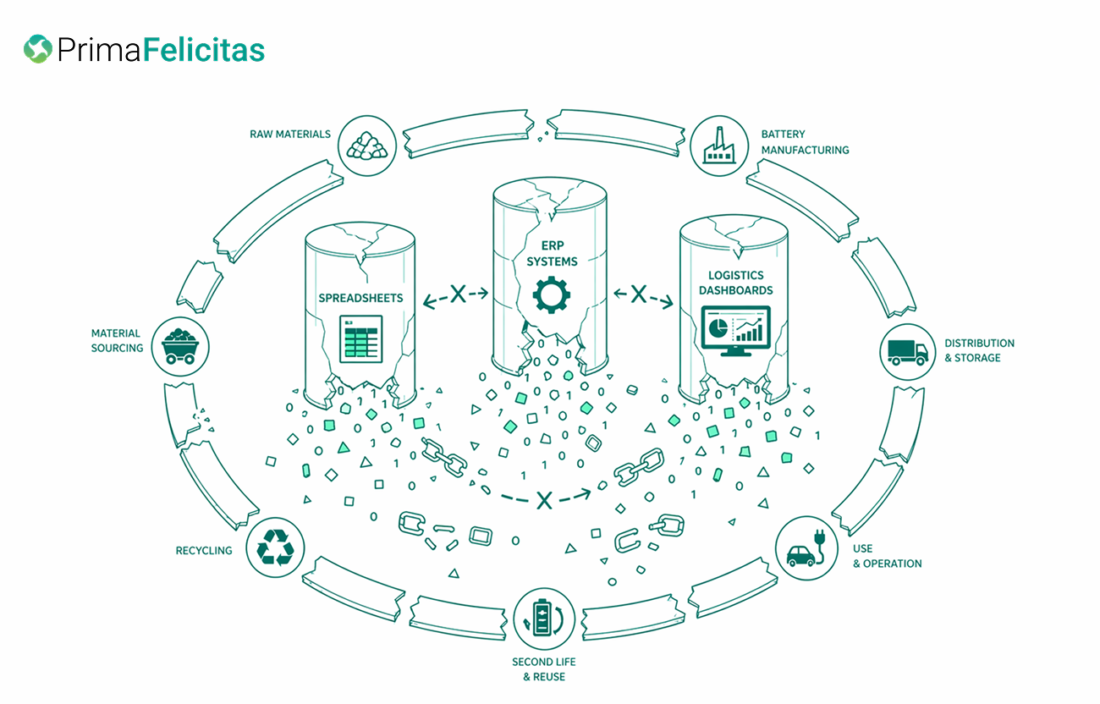
If we go deeper, then there is another issue with which firm is still juggling. These include fragmentation of ERP records, disintegrated databases, and outdated traceability structures that are unable to facilitate real-time passport intelligence. The unorganised and disseminated system renders battery lifecycle information priceless before it gets to the reuse or recycling categories.
This is the point at which the market changes radically, and to adjust to dynamic changes in the ecosystem, the traceability system is introduced. As the system keeps on maturing, so industries are also changing towards secure, interoperable architectures. These architectures are meant to sustain visibility of the supply chain, material checking, and compliance automation.

The Three Mute Margin Traps That Kill Battery Profitability.
European batteries have raised their standard more than ever before; they are now forcefully entering the traceability-first era. However, the regulation is not the only problem because most companies are not even aware of the areas where they are losing their value. The actual issue is that a structural solution and ineffective implementation will result in the annihilation of the battery ecosystem when reselling, value, and recycling margins, and secondary markets. In the EU regulation 2023/1542 battery regulation, it is not exactly recommended, but the producers are obligated to assume it as an accountability and responsibility. It must have a smart system, which brings transparency to the digital records on sourcing, manufacturing, use, repurposing, and recycling phases.
Sounds great, right? However, this appears very easy because as traceability developers, we have spent 10 years delivering the best tech ever. That way, we know that at the time of execution, it reveals cracks of deep operations; they can be sealed with a battery traceability solution. According to our observation, even well-capitalized companies experience derailed actions and ultimately declining profitability. This is because crucial lifecycle data are distributed among suppliers, OEM systems, logistics partners, and recyclers
JUST THREE Traps that should be identified.
TRAP 1: A data structure that is not structured, results in a fragmented lifecycle system. This is murdering asset value and all the valuable data of a battery usually remains in isolated outposts. This may include supplier spreadsheets, factory ERP systems, Logistics dashboards, and recycler databases.
Then the records of the lifecycle disintegrate between stages, such as when there is a need for improved histories, but it is not complete. At the same time, residual value is unpredictable, and buyers, particularly in the resale process, can hardly decrease their pricing certainty. A battery that does not have a reliable history turns into a discontinued asset.
TRAP 2: Unverified recovery data lowers the material premium. Take it like this: if the system recovered cobalt, lithium, and nickel and it proves the authenticity, then that can attract premium market pricing. If there is no authenticated chain of custody record, then metals that are recovered will count as downgraded. Along with that, it puts a gap between sellers and buyers. The industrial buyers will demand discounts and a delay in certification, increasing transaction friction.
TRAP 3: In this case, once the battery has been used after a long exposure, it will finally reach a point where it will obtain a second life. However, what occurs is that the second life market is unable to accommodate unidentified battery data. Because these data are incomplete and might not create that trust and worth while being utilized in further processes.
It is noted that the demand for second-life batteries in these industries where stationary energy storage is required is increasing rapidly. Other than that, priority for this category is in grid balancing systems as well as establishing a backup industrial power structure.
These industries are operating on entirely reliable lifecycle data, and it is risky to leave this data incomplete. The danger of the reusable business is the unverified data through the usage cycles, degradation cycles, and history of repairs. The old system of digital battery passports could not be depended on to do those executions, and thus they developed doubts among the buyers, and they went. It ultimately transforms reusable inventory into worthless scrap.
This is one of the hidden costs that they miss, but that, as an executive, they have to consider. Due to this, it poses a draining effect.
| Margin Trap | Commercial Impact |
| Fragmented Data | Lower resale valuations |
| Weak Provenance Proof | Discounted recovered metals |
| Incomplete second life records | Lost repurposing revenue |
There should be proper analysis; otherwise, many enterprises do not care about losses because they remain invisible. As these drawbacks are spread across departments, it’s really hard to find them at the same time. If, anyhow, these get identified, it is already too late, as they are multiplied. It affects the financial team while detecting margin erosion, but at that specific time, the lost opportunity gets into disposal pricing, resale discounts, and recycling inefficiency.
Primafelictas has been working for years to identify those traps and keep them on the checklist while developing a robust traceability system. The experts differentiate the approach so that the business can understand what goes wrong. This is how the company provides end-to-end instructions to the companies investing in Battery traceability systems.
Five Battery Passport Hacks That Transform Compliance Into Scalable Circular Revenue
There are companies in Europe that are experiencing success but do not want to consider the compliance-only regulatory burden. They are restructuring and brainstorming to make a greater battery economy. Their strategy revolves around how battery intelligence can create long-term commercial value beyond the first sale. This is where the whole mindset is taking a huge shift
The company who understand the status of EU battery regulation can capture and structure by activating Battery Passport Data effectively. Those companies can considerably remain in the profit in terms of stronger resale margins, better recycled material pricing, and higher value second-life battery channels. There is a distinction line that separates a market leader from leaders based on converting data into a profitable circular business model.
Moving further, these are the five strategies below that shift the entire narrative of battery profitability.
Convert Every Battery Into Revenue Into A Generating Digital Asset
One of the best arguments in favor of the digital battery passport is that it should not be considered a lifeless identity record. The actual value of it becomes visible when it is used as a dynamic digital asset profile, which is enhanced throughout the lifecycle.
Should an industry be producing a tsrutured battery passport, then it must be able to perform the following operations:
- Is able to capture material chemistry and composition details.
- Is able to capture carbon footprint and retain sourcing history.
- Examine the conditions of health and degradation patterns.
- Track the repair, replacement and maintenance records.
- Easy and smooth process to change ownership throughout the lifecycle phases.
- Good coordination in the process of handling the end-of-life and reuse classification data.
In a case where this intelligence is in place and constantly updated at various stages, then this becomes more readily applicable at will. This generates a financial architecture that generates profit and relates to an endless value chain. It provides assurance to the buyers and recyclers who are ready to make a contribution to the environment, to receive a genuine battery. Their intent will be commendable in case battery histories are complete, transparent, and auditable. That is what we can refer to as a full base of high-technology battery passport systems.
Build Premium Second Life Battery Markets Instead Of Scrap Pipelines
In the heading, it is evident that we should create a strong system that will facilitate a second-life battery system in an evolving ecosystem. The industry is yet to enjoy the revenue prospects in the current market. In that market, there are premature disposal batteries that still have a good amount of usable capacity. According to EQ International, used EV batteries are still of significant operational value, and it may be over 60 percent. Such batteries are priced less since customers are unable to determine the lifecycle performance. If these batteries are authenticated with detailed battery passport data, then these batteries can be considered at the time of premium Second Life Battery Sales procedures, like:
- It can be applied in the construction of renewable energy storage systems that are not mobile.
- Batteries with an authentic signature can be used to create an industrial backup power network chain.
- Businesses are able to develop grid balancing infrastructure and even commercial energy reserve systems.
There is a distinction between the battery, which is sold into the known second-life battery sales market, and another one which is simply sold into raw recycling streams. And so it is obvious that confidence in data turns to confidence in price.
Turn Verified Recovery Stream Into Premium Metal Revenue Channels
A battery is quite small, powerful tech due to its makeup. Once the composition of the bacteria is disturbed, the entire process is slowed down. One battery has lithium, cobalt, nickel, and manganese, which is useful in the purity of minerals. Due to this reason, the resale value is very sensitive to traceability.
The sourcing partners are now focusing on the authenticity of materials in industries. They take a step to think about the suppliers that have a proven and sustainable track record. Without a thorough and recognized origin, you know that records can not be taken into account. Then, these recovered materials of high quality are usually devalued in the pricing process.
The passport intelligence needs to be aligned with the recycling system by industries and then the companies can classify and certify confirmed recycled materials. This ultimately generates a number of quantifiable benefits that have a positive impact on the industry in various ways:
- In industrial channels of purchase, buyers readily accept the product.
- There will be no more delays in processes such as certification when reselling.
- Once the material batches get their purity authenticated, then it comes under higher trust premiums.
- It also creates a better negotiating value in the resale markets of the commodities.
As the amount of recycled content required in Europe increases, this will keep rising as a price gap between verified and unverified recovered materials.
Use Blockchain Architecture to Build Trusted Cross-Border Traceability
The above three will let the industry start with an execution, but the system should be valuable in the long term. To make it valuable, the system must be structured and aligned with balanced coordination. That will come with blockchain-enabled traceability, the battery supply chain industry juggles through inherently fragmented data.
For example, a raw material originates in one country, is manufactured in another country, and is reused /recycle occur elsewhere in Europe. The old legacy systems cannot maintain that level of data continuity across consistent changing environment. That is where blockchain-led passport traceability is emerging as the preferred architecture that creates the following value.
- Audit trails within the battery lifecycle will be immutable.
- Owners can be confident as the records are temperproof.
- Real-time cross-border chain-of-custody visibility.
- Assure verification of regulators, recyclers, and purchasers.
With all these, it is clear that we need to reinforce the traceability systems with compliance resilience and commercial intelligence. This is where strategic technological implementation is required, and Primafelicitas is empowering businesses by designing a versatile battery traceability system. The system comes with web3 architecture, AI intelligence, and scalable passport frameworks. The team is not only helping companies to set their standards as per the EU regulation, but also unlocking the monetizable lifecycle value from battery data itself.
Change The Approach: From Disposal Thinking To Circular Revenue Exchanges
There is still a category that thinks linearly when it comes to battery economics, but needs to think dynamically. And the model that those industries follow is out of date, so most advanced players are building a circular exchange ecosystem. The ecosystem supports retired batteries, they utilized in multiple monetization channels before recycling. They are treated differently and given a position in markets like:
- Channels that support the refurbishment module resale.
- Marketplaces where reusable second-life batteries are considered
- Certified recyclable material lots
- Component harvesting exchanges
Considering all these creates value that can be extracted in a way that it is a never-ending profitable approach. Rather than approaching it as one-time disposal pricing. This is where scalable Battery Recycling Revenue reaches its highest potential.
Choosing The Right Traceability Stack
| Technology Model | Strength | Weakness | Best Commercial Application |
| RFID-only Tracking | Efficient physical asset movement tracking | Limited lifecycle intelligence depth | Warehousing and logistics |
| Blockchain-only Systems | Strong transparency and audit integrity | Complex enterprise integration | Compliance-heavy ecosystems |
| Hybrid Blockchain + AI Stack | End-to-end lifecycle monetization visibility | Higher initial implementation cost | Full circular battery ecosystems |
ROI SNAPSHOT: turning the $100 M opportunity into reality
Lets us consier an enterprise processing and producing 5,00,000 retired batteries annually. And the enterprise has an optimized battery passport system that monetizes this much value across stages:
- An increase in the battery uplift of $80 by optimizing second-life resale.
- Recovery with premium verified materials at a price of $90.
- An increase of 70$ by circular exchange marketplace participation.
The total value annually becomes 240$ multiple by 5,00,000 that is 120$ million. This is why battery passport monetization becomes a part of attention among the big firms.
Battery traceability is now the next revenue infrastructure layer, and this can be possible when companies make digital architecture intelligently. For that purpose, there must be guidance and end-to-end experienced instructions. Companies are considering Primafelicitas from the last decade because they build blockchain-enabled AI-backed battery passport ecosystems. Their vision is to transform traceability compliance into scalable circular business growth.

From Regulation to Revenue: Real Battery Passport Momentum Across Europe
Above, we have made it clear that battery passport monetization is not just a so-called impressive conceptual approach. It is no longer isolated in the papers. They are deployed, tested, and generate output after the industry has standardized the process across Europe. The European Union has approached a consortium-led industrial programme involving the largest battery, automotive, and materials companies.
The data is not recorded for the sake of showing how hard the industry is working to create a commercial advantage. Rather, they are all initiative that shows Battery Passport Data is the foundation of a traceable circular battery value chain. What we have below is the proof that Europe’s battery economy is redefining the entire system. They are laying a vision and accountability among serious manufacturers, recyclers, and technology leaders.
Case Study 1:
Global Battery Alliance 2024 Pilots: The largest Real World Battery Passport Test So Far
In 2024, 10 industrial consortia came together with the Global Battery Alliance and major battery manufacturers to launch a large battery passport system. As per the GBA, companies that were participants have shown a significant capacity of over 80% of global EV Battery manufacturing. Thus making it the strongest benchmark yet for EU Battery Passport Readiness. Why do we care? We care because this pilot validated the following operations in real field situations.
Like lithium source traceability, cobalt provenance verification, carbon footprint declarations, and chain of custody transparency. These are some of the reliable operations that tell the Digital Battery Passport system is no longer a pilot concepts rather operational infrastructure. The infrastructure led the global battery market on different levels; without it, they cannot enter EU compliance without scalable interoperability.
Case Study 2
Europe passes blueprint keeping standardized battery intelligence; EU Battery Pass Consortium
The EU Battery Pass Consortium aligns with Audi, BASF, BMW, Circular TWAICE, Fraunhofer IPK, and Umicore. The alliance comes together to lay a foundation for Europe’s technical implementation framework for the battery passport. These big shots come forward to change the narrative on how Battery Passport Systems executes across industrial supply chains. They builtinteroperability standards, software demonstrations, lifecycle architecture models, compliance-ready implementations, and guidance with consortium development. This shows that profitability lies in intelligence flowing through manufacturers, suppliers, and recyclers.
Case Study 3
Umicore’s perspective on provenance: A Pricing Level In Recycling Markets
The Umicore company is based in Europe and keeps on working to make recycling a never-ending value machine. They strongly believe that the future value of circular battery recovery is possible when trusted digital provenance is linked to passport systems. This will create importance among recycled battery materials at the time of pricing. Because without traceable authentication, it is difficult to validate the battery, which causes:
- The recycled metals lose premium positioning.
- There is a reduction in procurement approvals.
- Industrial purchasers decrease the price confidence.
Because it is market relevant, for recyclers, provenance quality is emerging as commercially significant as material purity because of the emergence of authenticated Verified Recycled Materials.
Case Study 4
Battery Profitability Lies in the Software Architecture
In March 2024, Ciculor highlighted that software interoperability is central to future passport compliance. This creates a separate position as an architecture-driven system rather than just a policy-driven one. Enterprises are moving towards advanced Battery Traceability Solutions that are capable of following these aspects :
- Interopable API exchange
- Blockchain keeps the chain of custody logs safe and unchanged.
- Data can be synchronized at a scale.
Those case studies not only provide a motive but also break limitations of an industry looking for a versatile battery management ecosystem. You can be one of the industries if you have someone that is look up to this technology as the next big thing. It can be a partner, firm that are expertise in Web3, blockchain, and AI development working for decades.
Primafelicitas provides those capabilities as a strategic advancement for teaching to companies. They precisely execute and design in this transformation layer. The experts help enterprises to build a blockchain-enabled traceability ecosystem that connects Web3 architecture and intelligent battery passport design together. They look to create a scalable revenue-ready infrastructure.
Quik Snapshot For Clarity
| Initiative | Leading Participants | Strategic Proof |
| GBA 2024 Battery Passport Pilots | Global battery manufacturers | EU Battery Passport systems are entering real industrial scale |
| EU Battery Pass Consortium | Audi, BMW, BASF, Umicore | Standardized Battery Passport Systems are becoming operational |
| Umicore Circular Programs | Umicore + EU partners | Provenance is driving Verified Recycled Materials pricing |
| Battery Pass Technical Guidance | Fraunhofer, Circulor, consortium | Software-led Battery Traceability Solutions are now essential |
The Companies That Monetize Battery Intelligence Will Lead Europe’s Circular Future
This is a decisive phase, and the European battery economy is showing its real value. It is sure that by 2027, compliance with the battery passport regulation will be mandatory. We have to look at how industries are approaching Battery Passport Data. Are they looking at it as a measurable commercial advantage while implementing resale pricing, smarter recycling channels, and scalable circular revenue models? Because something is visible across Europe that is clear about the battery passport as a strategic profit infrastructure.
If you are the company that is shifting its approach towards traceability to make long term value. Then Primafelicitas helps forward-looking organizations to build a battery ecosystem for compliance readiness and future circular growth.
Post Views: 8


