Digital Battery Passport (DBP) is emerging as a strong digital solution to ensure accurate battery tracking and data traceability across the battery ecosystem. The passport contains end-to-end data from the battery manufacturing history, which includes raw materials procurement, ESG frameworks, and battery performance and health recorded at a later stage, as well as the recycling process. Each participant has their own responsibility to feed DBP with accurate and verified data. This necessitates the implementation of a robust system architecture to maintain transparency and overcome interoperability challenges.
This article covers the systematic DBP system architecture to support the successful implementation of the DBP initiative by the EU. In the latter part, we have also highlighted the key DBP interoperability and solutions to overcome them.
DBP System Architecture for Seamless Data Flow as Defined in EU Standardisation Requests
The Digital Battery Passport (DBP) system records and helps track data at each stage of the battery lifecycle. It involves multiple services for which the DBP system is divided into multiple components, combined to form the DBP architecture. Let’s discuss each of these components of BBP one by one-
European Commission Central Services
This layer defines the European Commission’s (EU) responsibility to ensure the effective implementation of DBP. Let’s explore what features are defined under this category-
- Unique Identifiers: A unique ID is generated for each battery to track it throughout its lifecycle. All data from the raw materials to their recycling is traced under one record.
- Data Carrier: The QR code or a digital medium that helps access the digital battery passport. It serves as the interface that allows users to access battery information.
- Registry: A centralised system that stores the references of the battery passport. The purpose is to index, recover, and create a lookup of battery-related records across systems.
- EC User Portal: It includes dashboards that help visualise and analyse battery data. It simplifies complex data and enables stakeholders to make informed decisions.
- EC Company Portal: A set of tools to manage battery-related data. It ensures accurate data sharing and detailed reporting.
- EC Authority Portal: It enables the regulatory authorities to analyse, verify, and monitor battery data.
- Distributed Data Repository: Battery data is stored across multiple locations to ensure data availability and avoid a single point of failure.
- Access Log Monitoring: The system tracks who accesses the data and the log time. This helps maintain transparency and accountability within the battery ecosystem.
- Querying of Passport Data: The system is designed in such a way that users can retrieve passport data efficiently.
- Data Modelling: Standard data modelling defines how data is structured, organised, and interlinked. It helps maintain consistency with data and also ensures interoperability.
- Identity and Access Control: This feature restricts data access within the battery passport ecosystem and safeguards API endpoints. The EU ensures that the control policies are implemented effectively with verified identities and roles of stakeholders.
- Data Integrity and Originality Verification: The digital infrastructure layer that confirms that the data is accurate and untampered. Technology such as blockchain can be used to create an immutable and verified record of all data and ensure that stakeholders and users that the data is from trustable source.
- Access Rights Management System: Battery data is made accessible based on the requirement. The system controls who can view, edit, or share battery data to ensure privacy and regulatory compliance.
- Authentication & Security Protocols: It is a set of protocols and technologies that verifies users and the system to prevent unauthorised access.
Also Read: How Enterprises Can Prepare Before EU Battery Regulations Deadline (2027- 2031)
Distributed DBP System Services
This layer is set up by individual operators, such as manufacturers and suppliers. They enable decentralised data management to ensure seamless data sharing and interoperability while ensuring regulatory compliance with EU standards.
- APIs for Data Request: It enables seamless exchange of data among the components.
- Distributed Data Repository: Battery data is stored across multiple locations to ensure data availability and avoid a single point of failure.
- DBP Conformance Verification: The system verifies DBP to ensure that it complies with regulations and required standards. It helps build a reliable DBP acceptable by all stakeholders and users across the battery ecosystem.
Third Party Services
Third-party services are offered by an independent service provider as specified under regulatory mandates. It includes-
Backup Services: A backup of battery data is created for recovery and to ensure that no data is lost.
This Digital Battery Passport (DBP) System architecture is designed carefully to enable manufacturers and battery-related companies retain control over their data while ensuring compliance with EU-defined standards.
Also Check: Four Levels of Battery Traceability Maturity
Interoperability Challenges with Digital Battery Passport (DBP) Implementation & Solutions
Digital battery passport is a complex system, as it involves multiple collaborations with participants across the battery ecosystem. Its implementation comes with interoperability challenges, which we have highlighted here-
- Maintaining Unique Identifiers: The key challenge with maintaining unique identifiers is duplicacy of IDs across diverse identification systems used by different operators. To address this issue, a globally unique identifier must be introduced and linked to a recognised framework.
- Connecting QR Code with Reliable Data Set: The QR code is static in nature, but the DBP data keeps evolving with time, such as battery performance, health, and recycling progress. While the dynamic linking mechanism is followed, i.e. connect QR code with a dynamic URL link, it is also important to ensure that the user connects with the updated datasets each time they scan the QR code.
- Routing within a Distributed DBP System: The key challenge with routing within the distributed DPP system is to ensure that the requested data is directed to the current data repository. It is especially necessary in case an operator exits from the battery ecosystem.
- Defining Technologies for Data Management: DBP systems are complex, and achieving full cross-sector interoperability due to the differences in data formats, standards, and systems is a task in itself. A federated data approach is relevant here as it enables companies to run their own systems and communicate through a common protocol. This helps maintain interoperability without requiring a uniform data system. It ensures that all participants understand the shared data.
- Maintaining Secure Supply Chain Management for Data Exchange: Maintaining transparency is crucial to tracing the flow of materials, batteries, and information. Methods like encryption, authentication protocols, and defining standardised data-sharing frameworks are essential to protect, verify and authenticate data access.
- Implementing Strong Access Control: The DBP is accessible to multiple stakeholders, like manufacturers, suppliers, recyclers, battery regulators, and consumers. While all participants need access to DBP, not all information is useful to all participants. Thus, a robust access control mechanism is necessary to ensure that data is accessible only when needed.
- Ensuring Continuous Data Flow for Improved Battery Traceability: Maintaining the DBP data record is challenging, as information is continuously updated with new data across the battery ecosystem. To address this, a dynamic data update mechanism is needed to timely synchronise with the system and minimise data gaps.
- Aligning with Global DBP Initiatives: DBP is being widely adopted by countries from across the globe. In case every region follows a different set of data formats and rules, systems won’t be able to communicate well. A joint program under the ISO Level for interoperability with international standards is a must to support the global adoption of the DBP initiative.
How is your organisation preparing for Digital Battery Passport implementation? Let’s discuss the challenges and opportunities. Connect with the PrimaFelictas team today!
How DBP Data Drives EV Adoption and Sustainability
DBP data enables seamless communication among components and systems to make informed decisions and support sustainability in alignment with regulatory compliance. Here is a detail on how DBP drives EV adoption and a long-term sustainable goal.
- Build Supply Chain Transparency: DBP enhances supply chain transparency by creating an end- to-end digital record of batteries used in EVs, from original production to use in the market. A detailed report on battery lifespan, performance, and health helps build trust with the use of EVs.
- Meet with Regulatory Compliance: All stakeholders associated with EVs and batteries must meet the EU regulatory compliance requirements. This ensures that a standard procedure is followed with battery implementation before the EVs are released in the market.
- Support Circular Economy: Battery material composition, its performance and health data help recyclers to make informed decisions when it comes to second-life battery usage. Judicious reuse and recycling of materials used in EVs, especially the battery, enable consumers to contribute to sustainable development with the use of EVs.
- Enhanced Consumer Trust: DBPs are also accessible to EV users with limited information. Users can access it with a single scan of the QR code available at the time of EV purchase. Sustainable practices and transparency with data availability enable more customers to be attracted towards EV usage.
- Improved Resale Value: A robust DBP system also records battery performance and health in real time using data collected from sensors. Once EVs battery lifecycle ends, it can still be utilised in a second life. The information is highly useful to quote the best resale price in the secondary market.
Also Read: How Digital Battery Passports Transform the EV Industry: From Mine to Recycle
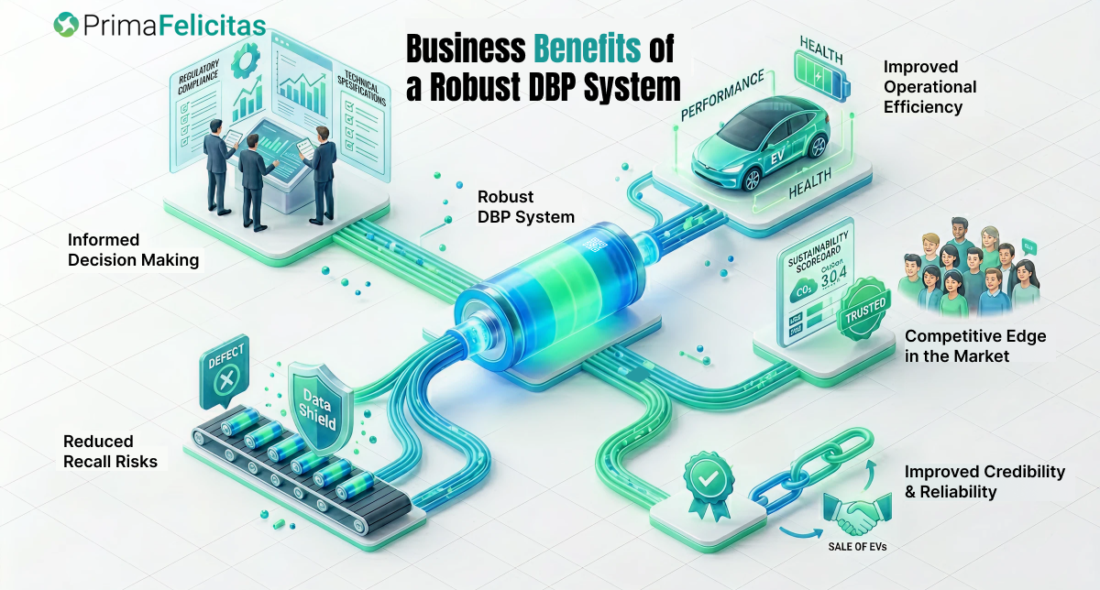
Business Benefits of a Robust DBP System
All stakeholders across the battery ecosystem, be it manufacturers, suppliers, recyclers and consumers, benefit from DBP.

Here is a detail on how companies associated with the batteries can make the best use of data to improve overall operational efficiency and reduce time and effort.
- Informed Decision Making: A well-structured technical record and data- driven insights act as a strong foundation for EVs and battery business leaders to make important decisions. DBP data can be used as a checklist for the implementation of technical specifications and regulatory compliance.
- Improved Operational Efficiency: Real-time data insights, such as battery performance and health supports predictive maintenance. This helps improve the overall EV efficiency and optimise resource utilisation.
- Reduced Recall Risks: Timely detection of defects with real-time updates on battery data prevents the company’s time and effort to bring the battery back to the site to fix it.
- Competitive Edge in the Market: Comprehensive carbon emissions data, regulatory compliance and documented procedures enable stakeholders and customers to build trust with the use of EVs to support sustainability on a large scale.
- Improved Credibility and Reliability: Verified DBP data can enable participants to trust the supply chain and all other activities, be it assembling or the sale of EVs.
Also Check: Digital Battery Passport (DBP): Driving Transparency & Sustainability Across the Battery Industry
How Recyclers Benefit from Digital Battery Passport (DBP)
Recycling of batteries for a second life is most crucial to support the circular economy. DBP is crucial for recyclers to ensure safe dismantling and also save time and effort required in the process. Here is a detail on how recyclers can benefit from DBP data.
- Improved Dismantling Process for Second Life of Batteries: Detailed DBP data on battery composition and guidelines on the use of specific tools save the time and effort of recyclers in the dismantling process.
- Safe Movement of Batteries: Risk assessment data with the release of harmful chemicals enables the logistics team to take necessary precautions while shifting the batteries for use or recycling purposes.
- Ease of Trade of Used Batteries: Information such as battery capacity, life span, degradation level after a certain period of time, battery performance and health can be traced using DBP. This helps the industry leaders to set a benchmark and determine the right rate for reuse in the secondary market.
Looking to build a scalable and compliant DBP solution? Let’s connect to explore how to get started. Contact us at primaFelicitas today.
Wrap Up!
The implementation and rapid development of the BDP system are not only useful to maintain transparency and efficiency, but also to develop a sustainable digital solution for the future. DBP architecture, comprising multiple components, each interlinked with APIs, helps ensure interoperability and maintain transparency within the battery ecosystem. A well-designed DBP system helps assign identity, define access control and ensure the authenticity of data.
The right implementation of technical standards, regulatory compliance, and strict EU and global regulations will further strengthen DBP adoption to support long term commitment.
Now is the time to invest in the development of efficient battery traceability solutions and stay ahead with their global adoption. Let’s connect to discuss how to build a future-proof DBP digital solution and how to overcome challenges as DBP scales on a large scale.
Contact the team of PrimaFelicitas today!
Post Views: 24


