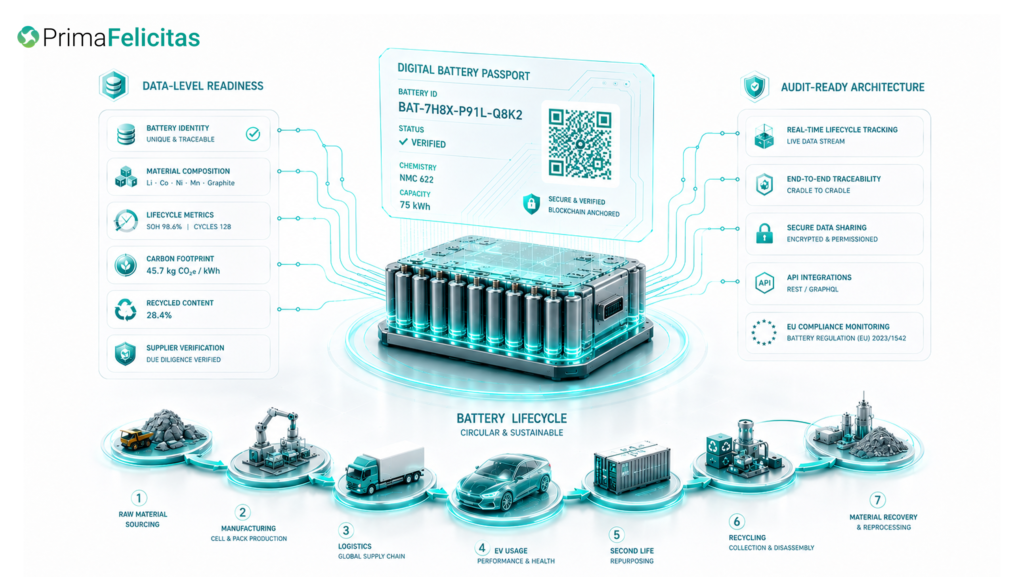
EU Battery Regulation 2023/1542 expects companies to prepare at all levels to ensure End-to-End Battery Traceability. The mandatory Digital Battery Passport solution for EV batteries, rechargeable industrial batteries typically with a capacity above 2 kWh, and LMT batteries must comply with regulatory requirements, failing which they may face restricted access to the EU market.
An audit-ready Digital Battery Passport reflects readiness at data, architecture, system, and governance levels. An extensive audit readiness assessment is a self- driven approach to ensure-
- Real-time lifecycle tracking
- End-to-end battery traceability
- Secure and controlled data sharing
- Regulatory compliance readiness
- Interoperability across systems and stakeholders
Hence, focus should be on all aspects, from architectural design to regulatory readiness.
Without an effective Digital Battery Passport solution across the battery lifecycle, the company may face-
- Fragmented data across stakeholders
- Structural gaps impacting data validation and audit readiness
- Limited traceability across the battery lifecycle
- Unreliable carbon footprint and sustainability reporting
- Increased risk of non-compliance with EU regulations
Here is a guideline on how companies can ensure DBP readiness as per EU battery regulations.
Data-Level Readiness for Battery Traceability
Audit readiness at the data level sets the foundation of an effective Digital Battery Passport. Organisations must ensure the data is complete, accurate, and audit-ready. Here are the key metrics and features that need to be considered.
Key Data Metrics-
- Unique Battery ID
- List of critical raw materials such as Li, Co, Ni, Mn, graphite
- Battery capacity and energy under standard conditions
- Manufacturers, traders, and suppliers’ names and locations
- Battery model and category
- Battery chemistry
- Gross weight & dimensions
- Serial number unique to cell batch
- List of critical raw materials
- Battery expected lifespan
- Recycled content percentage
- Details of hazardous substances
- Carbon footprint per kWh
- Supplier due diligence records
Key Features to Audit-
- Unique Battery Identification: Ensure a unique identifier (QR/ RFID) is assigned to batteries to track them across the lifecycle, from manufacturing to recycling.
- Data Quality and Validation: Conduct an extensive test to ensure accuracy, completeness, and reliability of input data.
- Standardised Data Structure: Ensure a consistent schema for the battery attributes, such as source and origin of materials, composition, performance, and more, to avoid fragmented data across the battery ecosystem.
- Data Consistency and Normalisation: Cross-check for data format uniformity across suppliers, manufacturers, and recyclers.
- Data Traceability Mapping: Capture how data is generated and shared at different levels to ensure full traceability.
Build a secure, audit-ready data foundation for Digital Battery Passport. Connect with us at PrimaFelicitas for a comprehensive data readiness audit.
End-to-End System Readiness for Lifecycle Management
End-to-end DBP audit readiness ensures seamless data exchange and visibility across the battery lifecycle. An interoperable system aligns manufacturers, OEMs, suppliers, recyclers, and other participants. A robust system sets the right infrastructures to ensure real-time visibility, scalability, and interoperability.
Here are technical specifications and features to consider when auditing with the digital battery passport solution.
Key Metrics and Technical Specifications-
- List of stakeholders, suppliers, OEMs, and recyclers across the battery ecosystem
- Number of interconnected systems across the battery lifecycle
- Scalability to handle the increasing volume of data and participants
- Interoperability to meet regional and global standards
- Degradation curve or C-rate performance data
- State of Health (SoH) monitoring protocol
Key Features to Audit-
- End-to-End Integration: Ensure seamless data flow across systems, be it a manufacturing site or a recycler
- Interoperability Framework: Validate if the system is compatible across diverse platforms and systems
- Real-Time Synchronisation: Verify for real-time updates that are reflected instantly within the system.
- Scalable System Infrastructure: Analyse if the system can handle the growing volume of data without degrading performance.
- API Architecture & Integration Readiness: Access API design, authentication protocols, and throughput performance to ensure low-latency with data exchange across distributed systems.
- System Reliability: Analyse systems’ performance, resilience, and availability to ensure uninterrupted operations at all levels.
Identify system gaps that might affect traceability and performance. Build a future-ready Digital Battery Passport solution. Contact the team at PrimaFelicitas.
Security & Access Control Readiness
A secure Digital Battery Passport (DBP) framework is needed to ensure the seamless exchange of sensitive information and prevent unauthorized tampering of records. A structured approach throughout the battery lifecycle helps build trust in the process and holds participants accountable for their activities.
Here are metrics to consider to ensure security regulatory compliance across the battery ecosystem.
Key Security Metrics to audit-
- Restricted access to sensitive data
- DBP is hosted to EU-accessible digital platform
- QR/ RFID connected to a live and updated DBP
- All API integrations are tested across partners
- Version control is properly documented
Key Security Features to Consider –
- Role-Based Access Control Mechanism: Verify if role-based access controls are implemented
- Authentication & Authorisation Mechanisms: Confirm that DBP is hosted to EU-accessible digital platform
- Data Encryption & Protection: Ensure restricted access to sensitive data
- Secure Data Exchange: All API integrations must be tested with partners
- Timestamp of all logs: Version control must be properly documented, and updates must be recorded to support accountability.
Assess DBP security readiness. Identify gaps before they become compliance risks.
Sustainability & ESG Metrics
Ensuring sustainable practices with the Digital Battery Passport requires the team to verify ESG performance across the battery lifecycle. All metrics must be backed with auditable data.
A well-structured ESG readiness ensures transparency with the process and adds credibility to the procedure. Here are the key metrics and features to consider.
Key metrics
- Full traceability of carbon footprints
- Handling and transportation guidelines
- Percentage of renewable energy used in manufacturing
- ESG score from a recognised body
- Social standards followed
Features
- Ethical Sourcing Standards: Ensure that social and labor standards are followed across the battery supply chain.
- End-to-end carbon footprint tracking: Verify end-to-end carbon footprints across sourcing, production, usage, and recycling
- Compliance with Sustainable Logistics: Ensure that environmental guidelines and safety concerns are followed during handling and transportation.
- Verify ESG Benchmarking: Ensure that ESG scores are granted from a recognised and credible rating body
- Circularity and Recycling Process: Verify recycled content and material recovery rates across the battery ecosystem
Why Companies Must Prioritise DBP Audit Readiness Assessment
An audit readiness assessment provides a clear view of how prepared they are, not just with verified and accurate data, but to scale and build a robust digital battery passport solution. It enables the team to identify hidden gaps, ensure alignment with stakeholders, and minimise risk at an early stage. Here is how companies can further benefit by taking a DBP audit readiness assessment.
- Avoid rework and delays: Identifying gaps with the architecture and data flow across the battery lifecycle helps fix issues early on and avoid delays with its implementation.
- Make informed decisions with confidence: Clear visibility into data, system, and process enables leaders to make informed, insight-driven decisions.
- Build trust with partners: By demonstrating audit readiness, trust is built among OEMs, regulators, and partners. It enables organisations to position themselves as reliable and complaint-ready.
- Minimise risk: Early audits help teams to fix gaps early on and reduce risks during regulatory audits.
- Build a strong foundation: By setting the right standards, companies can ensure that the Digital Battery Passport solution is scalable with the increasing volume of data, participants, and evolving regulations.
Preparing for EU market entry? Ensure your Digital Battery Passport is aligned with registry and regulatory requirements. Get in touch with our expert at PrimaFelicitas to discuss challenges and solutions to overcome them.
Digital Battery Passport Registry Readiness & EU Market Access
Companies have less than a year to prepare for battery passports as per the EU Battery Regulation (EU) 2023/1542. Audit readiness will enable them to secure their position in the EU market. Here is what companies need to consider-
- Understand the registry process and complete the process before the deadline
- Focus on the complete process and not just data
- Ensure to implement role-based access across the battery ecosystem for security purposes
- Take an extensive audit readiness assessment to verify data and processes before a regulatory audit
- Validate the internal system and data before submission to the European Commission to avoid delay, rejections, or restricted access to the EU market.
Designing a Scalable and Future-Ready Digital Battery Passport Solution
As the Digital Battery Passport evolves, organisations must invest time and effort in ensuring that the systems they design are not only audit-ready but also adaptable for the future. Future-ready Digital Battery Passport demands flexibility, scalability, alignment, and interoperability with the evolving battery ecosystem. Here is a delta on how to ensure that the Digital Battery Passport Solution is future-ready.
- Design scalable DBP solutions: The Digital Battery Passport (DBP) solution must be designed to adapt to the evolving data, regulatory, and battery ecosystem. The framework must meet the compliance and support requirements in the long term.
Scalability must be met at the system level, which means handling a large volume of data, ensuring seamless onboarding of suppliers and partners, and seamless integration of systems at all stages.
- Compatibility with the regulatory system environment: Future-proofing the digital battery passport also depends on alignment with standards and digital infrastructure as defined by the European Commission. Companies must ensure that the DBP solutions are compatible with the EU regulatory system environment to avoid delays in rework.
- Continuous Improvement: Companies must regularly monitor the system to improve their strategy and processes in alignment with regulatory changes. By investing in scalable and adaptable infrastructure, companies can build a resilient platform for Digital Battery Passport solutions and remain competitive in the evolving EU market.
- Interoperability Across Battery Ecosystems: Leaders must ensure that the DBP solutions they are building can integrate seamlessly with multiple platforms and digital ecosystems. An audit readiness test can help them verify standardised data exchange, ensure flexible architecture, and effective collaboration across the battery ecosystem.
- Adaptable to Regulatory Changes: Companies must focus on designing a system that adapts to data updates, version upgrades, and regulatory standards. It prepares them for long-term compliance and ensures meeting regulatory changes.
Wrap Up!
Digital battery passport is an entry ticket for batteries under the EU Battery Regulation 2023/154 with a deadline approaching February 18, 2026. Organisations included under these regulations can no longer work in silos but must adapt to meet the end-to-end requirements and ensure interoperability at all stages.
All participants across the battery ecosystem play a crucial role in building a future-ready Digital Battery Passport Solution and compliance readiness.
An early Digital Battery Passport audit readiness assessment reduces the risk of missing regulatory guidelines and improves the overall progress of building a robust DBP solution. Companies that act early are in a better position to pass the regulatory audits and avoid delays in entering the EU market.
An end-to-end audit readiness from data accuracy to system interoperability is a must to ensure compliance. It not only reduces risks but also helps build trust across the battery ecosystem and evolve with the regulations set by the European Commission.
At this, companies’ focus must be on validating data, systems, and aligning with partners to build a strong foundation for Digital Battery Passport solutions.
Build a scalable and future-ready DBP solution. Connect with the PrimaFelicitas team to strengthen the readiness for regulatory audit and accelerate DBP implementation.
Post Views: 38